
"Moving to E5 has been really good from a security point of view... Now we can get a holistic view of what’s going on, which helps us to make changes and recommendations for future plans."
IT Service Manager
Ian Harkess
Trusted by industry leaders
Kickstart Your FastTrack Journey
Fill out the short form below to express your interest in our FastTrack programme, and we’ll be in touch soon.
Please note: A minimum of 150 enterprise licenses is required for FastTrack eligibility.
“We needed to find solutions to a variety of issues whilst being a complex business, operating in a 24/7 environment. Stripe OLT listened and understood immediately the challenges we faced.”
IT Operations Manager
Simon Darley
Trusted by industry leaders
Let's Talk
Call us on one of the numbers below, we cover the whole of the UK, so call the nearest office.
“We needed to find solutions to a variety of issues whilst being a complex business, operating in a 24/7 environment. Stripe OLT listened and understood immediately the challenges we faced.”
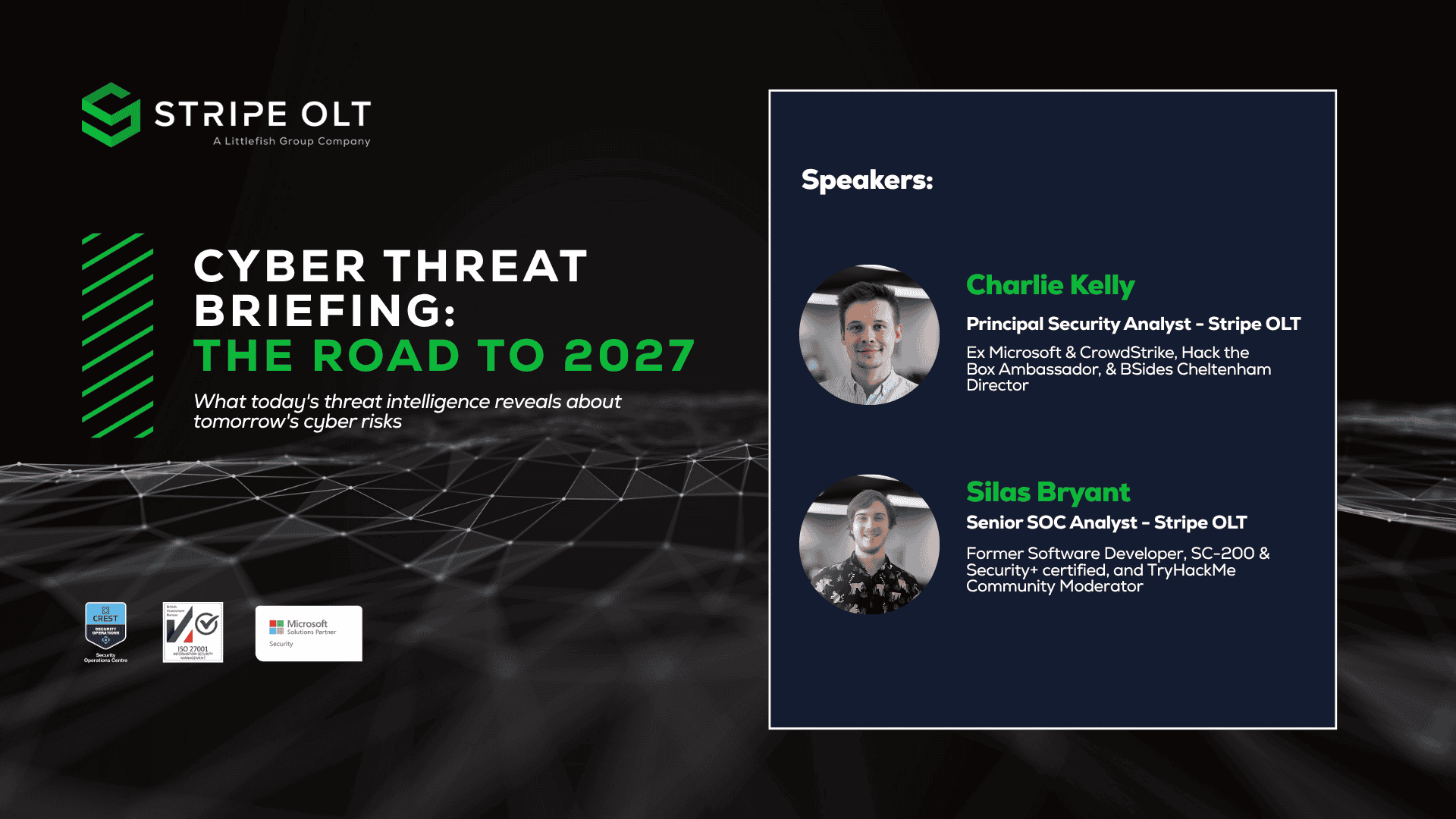
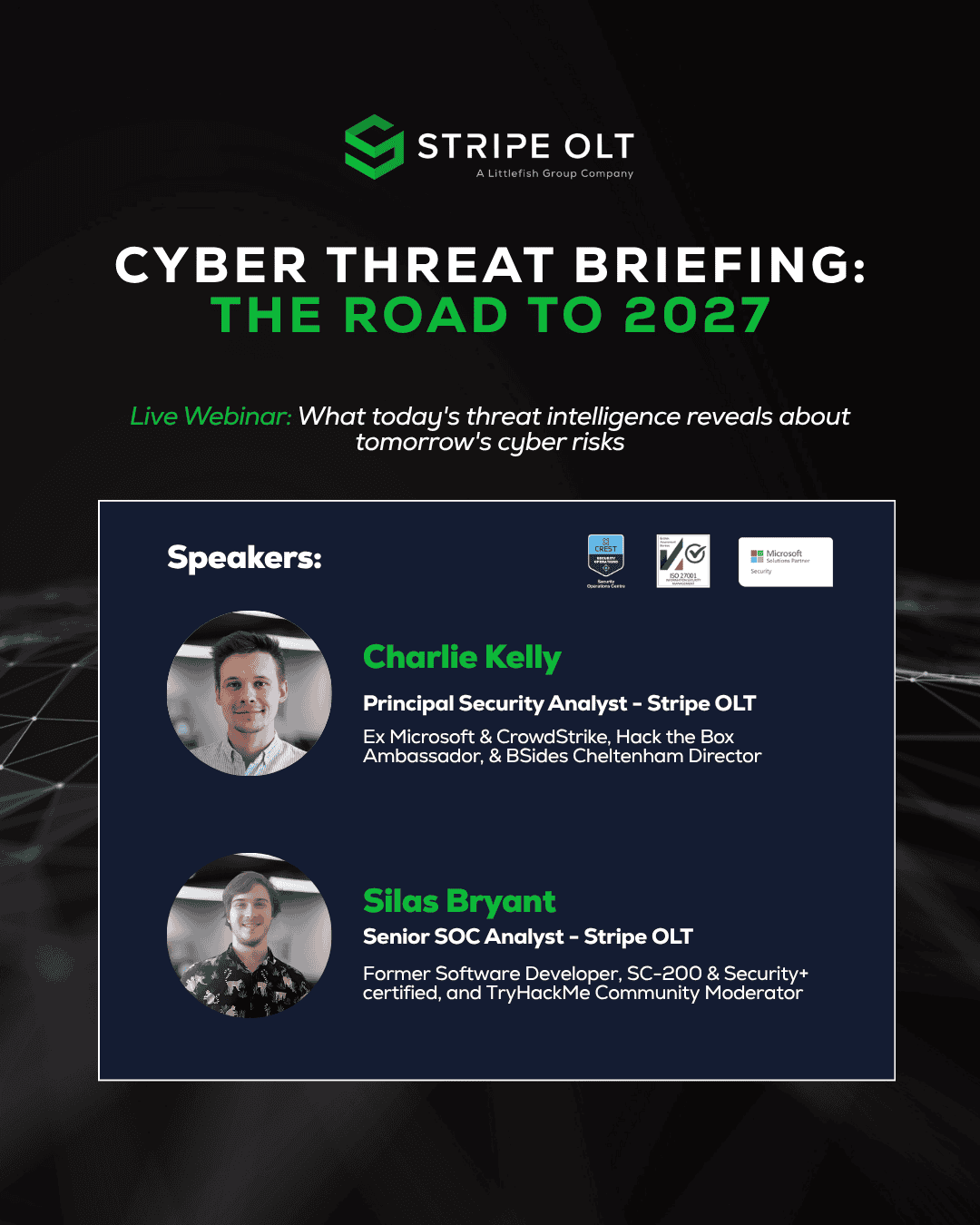
This Expert Intel summarises the key cyber security themes from CYBERUK 2026, exploring how AI is accelerating attacker capability, why identity remains the primary control gap, and what UK based organisations should prioritise to strengthen detection, response, and supply chain resilience.
The next 12 months will favour organisations that get the fundamentals right. Those prioritising identity, strengthening supply chain resilience, and achieving true operational visibility, rather than those simply stacking more security tools.
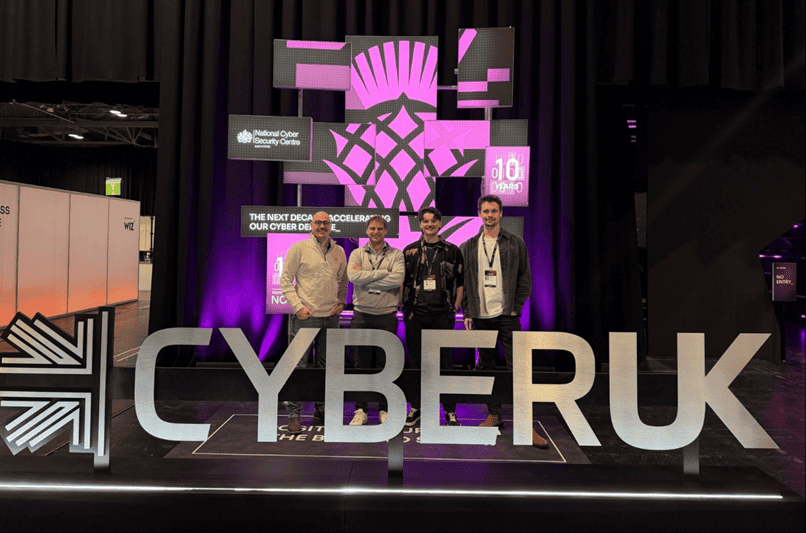
Caption:Stripe OLT on site at CYBERUK 2026
CYBERUK 2026 reinforced a clear message – the cyber threat landscape is accelerating faster than most organisations are adapting to it.
AI is lowering the barrier to entry for attackers, identity remains the weakest link across environments, and the organisations that succeed will be those that prioritise detection, response, and operational clarity over simply adding more tools.
At the same time, frameworks like Cyber Essentials are evolving, with a stronger focus on outcomes, supply chain resilience, and real-world impact.
So, what should you actually be paying attention to? Let’s get into it.
1. Attackers Are Scaling Faster Than Defenders
One of the most consistent themes across sessions was the speed and scale advantage attackers now hold.
AI is enabling:
Rapid phishing campaign generation
Automated reconnaissance at scale
Faster malware development cycles
More convincing social engineering
The result is a shift towards:
Higher-frequency, lower-cost attacks
Faster infrastructure rotation
Increased use of AiTM and credential harvesting techniques
Key Takeaway: This means attacks are no longer rare or targeted events. They are continuous, scalable, and increasingly automated.
2. Identity Is Still the Primary Control Gap
Despite years of focus, identity security remains the most common point of failure.
Across discussions, there was strong emphasis on:
MFA enforcement across all users
Conditional access policies aligned to risk
Privileged access control and monitoring
Broader Zero Trust adoption
This aligns with what we see across SME environments – identity controls are often in place, but not consistently enforced or optimised.
Key Takeaway: Identity is no longer just an access control. It is the primary attack surface.
3. Detection and Response Now Define Security Maturity
A notable shift in messaging was the move away from tooling as the primary measure of security.
Instead, focus is shifting towards:
Speed of detection
Quality of triage
Automation of response
Clearly defined escalation paths
Organisations with mature Security Operations Centres are differentiating themselves not by what they own, but by how effectively they respond.
This reinforces the importance of:
24/7 visibility
Clear incident response processes
Reducing alert fatigue through automation
Key Takeaway: Partner with a SecOps team that specialises in your organisation’s core technology stack and operates in line with best-practice frameworks such as CREST SOC.
4. Critical Infrastructure Risk Extends to the Supply Chain
Threats to Critical National Infrastructure (CNI) were highlighted as a top priority, particularly across:
Energy
Water
Transport
Telecommunications
However, the key insight for SMEs is this:
You do not need to be CNI to be treated as part of the attack surface.
Organisations that support CNI supply chains, including MSPs and technology providers, are increasingly being targeted as indirect entry points.
This aligns with the direction of the Cyber Security and Resilience Bill, which places greater emphasis on supply chain accountability and resilience.
5. Cyber Essentials Is Evolving – and Becoming More Relevant
Supporting Insights from Charles Okeden, Cyber Essentials Programme Manager:
Greater flexibility to reflect real-world environments
Increased focus on supply chain assurance
A standout example shared was St. James’s Place, where Cyber Essentials adoption across a network of over 2,800 businesses led to an 80% reduction in security incidents.
Additional insights:
Certified organisations report fewer breaches and improved resilience
Awareness of Cyber Essentials remains low across UK SMEs
Caption:Key speakers delivering a session on Cyber Essentials at CYBERUK 2026
5. Cyber Essentials Is Evolving – and Becoming More Relevant
Despite its proven value, Cyber Essentials still faces adoption challenges:
Many UK businesses remain unaware of the scheme
Some organisations perceive it as too basic
Adoption is often driven by client requirements rather than a proactive strategy
Interestingly, one of the most effective ways to drive adoption across supply chains is through commercial channels, rather than purely security-led conversations.
Key Takeaway: Frameworks like Cyber Essentials should already be a core part of your security baseline – proven to significantly reduce the impact of incidents, and essential for any organisation serious about resilience.
6. The Cyber Essentials Challenge – Awareness and Adoption
Across all themes, a consistent pattern emerges:
Attackers are unsurprisingly moving faster and scaling more efficiently
Identity remains the weakest control layer
Detection and response remain a critical capability
Supply chain exposure is increasing
Baseline frameworks like Cyber Essentials are becoming more important, not less
This is not about reacting to individual threats. It is about building a security posture that can adapt to continuous change.
We’re Here to Support You
The themes coming out of CYBERUK 2026 reflect what we are already seeing across our client base – increasing attack volume, identity-led compromise, and growing pressure on supply chain security.
At Stripe OLT, we work closely with organisations to:
Strengthen identity and access controls
Improve detection and response capability
Align Cyber Essentials with broader security strategy
Provide visibility and confidence across your environment
If you want to understand how these insights translate to your organisation, or sense-check your current security posture, speak to our team.
This website uses cookies. By using this site you agree to our use of cookies. We use cookies to enhance your experience. To understand the specific cookies we use and how we handle your data, see out Cookie Policy, Privacy Policy and Terms & Conditions. Manage your preferences at any time by clicking the 'View Preferences' button.
Functional
Always active
The technical storage or access is strictly necessary for the legitimate purpose of enabling the use of a specific service explicitly requested by the subscriber or user, or for the sole purpose of carrying out the transmission of a communication over an electronic communications network.
Preferences
The technical storage or access is necessary for the legitimate purpose of storing preferences that are not requested by the subscriber or user.
Statistics
The technical storage or access that is used exclusively for statistical purposes.The technical storage or access that is used exclusively for anonymous statistical purposes. Without a subpoena, voluntary compliance on the part of your Internet Service Provider, or additional records from a third party, information stored or retrieved for this purpose alone cannot usually be used to identify you.
Marketing
The technical storage or access is required to create user profiles to send advertising, or to track the user on a website or across several websites for similar marketing purposes.