"Moving to E5 has been really good from a security point of view... Now we can get a holistic view of what’s going on, which helps us to make changes and recommendations for future plans."
IT Service Manager
Ian Harkess
Trusted by industry leaders
Kickstart Your FastTrack Journey
Fill out the short form below to express your interest in our FastTrack programme, and we’ll be in touch soon.
Please note: A minimum of 150 enterprise licenses is required for FastTrack eligibility.
“We needed to find solutions to a variety of issues whilst being a complex business, operating in a 24/7 environment. Stripe OLT listened and understood immediately the challenges we faced.”
IT Operations Manager
Simon Darley
Trusted by industry leaders
Let's Talk
Call us on one of the numbers below, we cover the whole of the UK, so call the nearest office.
“We needed to find solutions to a variety of issues whilst being a complex business, operating in a 24/7 environment. Stripe OLT listened and understood immediately the challenges we faced.”
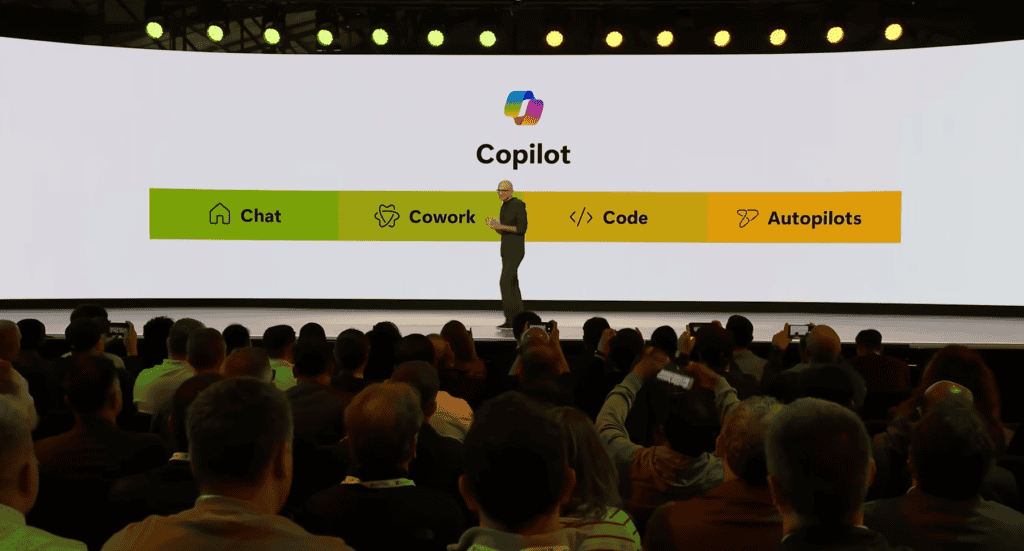
Microsoft Ignite 2025 delivered major updates that make AI safer, more accurate and easier to use at scale, with new tools for governance, context, model optimisation, secure automation and user skilling.
“Copilot becomes dramatically more accurate when it understands how your business works, not just what data you store.”
Microsoft Ignite delivered another huge year of AI announcements, but most business leaders don’t have the time (or desire) to scroll through hundreds of pages of keynotes, documentation, and deeply technical blogs.
So, we’re breaking down key updates to save you time and help you understand:
Which reduces security risk
Which increases efficiency and reduces cost
And which will impact how your teams work in 2025
Keep reading for bite-sized technical insights you can easily share with your wider team.
1. Agent 365: Governance for Your AI Workforce
AI agents are fast becoming your extra digital workers: analysing data, automating tasks, generating content, triaging signals, and interacting with a number of different business systems. Until now, they’ve largely operated without identity or governance. Agent 365 helps alleviate that.
It introduces a dedicated governance layer for AI agents within Microsoft 365, including:
Entra Agent IDs (first-class identities for agents)
Least-privilege policy templates
Agent-to-resource mapping and visualisation
Full integration with Defender and Purview
Why this matters:
Shadow agents and uncontrolled access are now one of the fastest-growing risks in modern IT estates. Agent 365 provides a credible framework for governing AI at scale.
Want to know more? Further reading for your IT & security team:
Potentially an obvious statement, but one we all know by now… Most AI failures have the same root cause: poor context.
Work IQ is Microsoft’s new context engine that helps to alleviate that – it’s being described as the intelligence layer behind Copilot and custom agents. It combines organisational data, roles, relationships, routines, and sensitivity labels into a secure, permission-aware context model.
In practice, this should mean, it introduces a dedicated governance layer for AI agents within Microsoft 365, including:
Fewer hallucinations
More relevant outputs
AI actions aligned to the user’s role and permissions
Why this matters:
Copilot becomes dramatically more accurate when it understands how your business works, not just what data you store.
This is a major step forward. If your data foundations are solid, Work IQ will noticeably improve Copilot’s usefulness.
Want to know more? Further reading for your governance team:
The Model Router automatically selects the best AI model for each prompt – OpenAI, Anthropic, Llama, DeepSeek and more.
As we understand, it includes 12 models, such as GPT‑5 family, GPT‑oss‑120b, DeepSeek‑v3.1, Llama‑4‑Maverick‑17B‑128E‑Instruct‑FP8, Llama‑33‑70B‑Instruct, Grok‑4, and Grok‑4‑fast.
Why this matters:
Your teams can work through a single, optimised endpoint – meaning they no longer need to switch between AI models to get the right result for the task at hand. For your business, this reduces the risk of vendor cost spikes and model drift as the AI landscape evolves. It’s the fastest way to deliver consistent, high-quality outcomes internally without building complex orchestration logic yourself.
Want to know more? Further reading for developers & data teams:
4. Microsoft × Anthropic × NVIDIA: Model Diversity
A BIG announcement – Microsoft announced a partnership with Anthropic, bringing Claude models into Azure and across the Copilot ecosystem, alongside significant NVIDIA-backed infrastructure commitments.
Why this matters:
You gain access to a broader range of frontier models
Azure becomes the only cloud hosting both OpenAI and Anthropic
Real resilience against reliance on a single model provider
Model diversity it’s now seemingly part of a smart business resilience strategy.
5. Sales Development Agent: Governed Pipeline Automation
This is Microsoft’s first “autonomous agent” built directly on the Agent 365 framework I mentioned earlier. It can research accounts, qualify leads, draft outreach and operate after hours (sounds amazing, right?).
Why this matters:
It’s a potential blueprint for scaling basic sales activity to support your senior sales team.
Want to know more? Further learning for CRM teams:
Project Opal allows AI agents to perform multi-step workflows inside a secure, isolated Windows 365 “Agent Cloud PC.”
Use cases include:
HR onboarding
Timesheet chasing
Procurement administration
Evidence collection for audits
Data entry tasks
Why this matters:
It provides a safe environment for automation without exposing your live estate. This could be one of the fastest ways to reclaim hours of admin time – without the risk of data leakage.
Want to know more? Further reading for operations and automation teams:
7. AI Skills Navigator: Education for General Users
Microsoft have released a unified hub combining Microsoft Learn, LinkedIn Learning and GitHub, with personalised, role-based skilling pathways.
Why this matters:
To adopt AI correctly, your teams need structured AI skill development. Tools alone don’t create adoption – practical application does.
Potentially one of the most underrated Ignite announcements, because If you don’t build internal capability with your users, AI initiatives will stall quickly.
Prioritising the right foundations will determine how quickly and safely your organisation can scale AI. Focus on:
Use cases include:
Agent 365 for governance
Work IQfor meaningful context
Model Router for consistency and cost control
Project Opal for secure automation
Sales Development Agent for pipeline acceleration
AI Skills Navigator for building internal capability
With these pillars in place, you’ll be positioned to adopt AI safely, confidently, and with measurable impact.
If you’re ready to take Copilot and broader AI adoption seriously – whether that’s governance, training, benchmarking, or building an AI-ready foundation – our team can connect you with the right experts and our proven AI readiness approach.
From AI agents to enhanced Copilot capabilities, June’s Microsoft Build highlighted how organisations can move from AI experimentation to practical, business-focused adoption.
We’re proud to share that our Director, Mark Dale, has officially been awarded the IT Nation, Evolve Partner of the Year 2025 this week, recognising his leadership, Stripe OLT’s commitment to innovation, and the impact the whole team make on the IT community.
AI systems generate plausible answers, not verified truth, meaning misinformation can quickly surface in business workflows. For UK SMEs adopting AI, output validation and governance must now form part of core cyber security controls.
Stripe OLT has achieved the Microsoft Cloud Security Specialisation, proving our expertise in securing Azure and Microsoft cloud environments. Learn what this means for your business.
Stripe OLT is now part of the Microsoft FastTrack Program, giving SMEs direct access to expert-led cloud adoption, security, and digital transformation - at no extra cost. Find out how this accelerates your IT resilience?
Don’t let cyber criminals turn your holiday deals into a data breach. Check out our bite-sized security guide to keep your users, and your business, safe this shopping season.
Across the world, Windows computers have been affected the dreaded Blue Screen of Death (BSOD). This appears to have been caused by an outage of services provided by cyber security provider, CrowdStrike. The issue appears to have impacted a large number of organisations - from banks to airlines. Here are the current advisories.
Stripe OLT has been recognised by Cloudtango as one of the UK's top Managed Service Providers (MSPs) for 2024. Selected from more than 10,000 UK providers, this recognition highlights our commitment to technical excellence, innovation, customer satisfaction and delivering outstanding managed IT services.
We're thrilled to share the news: Stripe OLT has been recognised as one of the top 50 emerging stars at the prestigious Megabuyte100 Awards 2024. These awards stand out in the UK's tech landscape, offering an unbiased, expert analysis of companies' financial prowess via the Megabuyte Scorecard.
This website uses cookies. By using this site you agree to our use of cookies. We use cookies to enhance your experience. To understand the specific cookies we use and how we handle your data, see our Cookie Policy, Privacy Policy and Terms & Conditions. Manage your preferences at any time by clicking the 'View Preferences' button.
Functional
Always active
The technical storage or access is strictly necessary for the legitimate purpose of enabling the use of a specific service explicitly requested by the subscriber or user, or for the sole purpose of carrying out the transmission of a communication over an electronic communications network.
Preferences
The technical storage or access is necessary for the legitimate purpose of storing preferences that are not requested by the subscriber or user.
Statistics
The technical storage or access that is used exclusively for statistical purposes.The technical storage or access that is used exclusively for anonymous statistical purposes. Without a subpoena, voluntary compliance on the part of your Internet Service Provider, or additional records from a third party, information stored or retrieved for this purpose alone cannot usually be used to identify you.
Marketing
The technical storage or access is required to create user profiles to send advertising, or to track the user on a website or across several websites for similar marketing purposes.